Clavicle Fracture Plate Fixation: Full Recovery from Comminuted Collarbone Break
🦴 Clavicle Fracture & Plate Fixation: Understanding the Injury and its Treatment 🔩
- The clavicle, or collarbone, is a long, slender bone connecting the sternum to the shoulder.
It plays a vital role in shoulder movement and upper limb function. Clavicle fractures are
common, especially in contact sports, road traffic accidents, or falls directly onto the
shoulder.
💥 Common Signs of a Clavicle Fracture:
- Pain and swelling over the collarbone
- Visible deformity or “bump”
- Difficulty lifting the arm
- Bruising or grinding sensation at the fracture site
🛠️ When is Plate Fixation Needed?
While many clavicle fractures can heal with conservative treatment (like a sling), surgical
fixation with a plate and screws may be advised in the following cases:
- Displaced or overlapping fracture fragments
- Open (compound) fractures
- Comminuted (multi-piece) fractures
- Non-union or malunion
- High-performance athletes requiring faster recovery
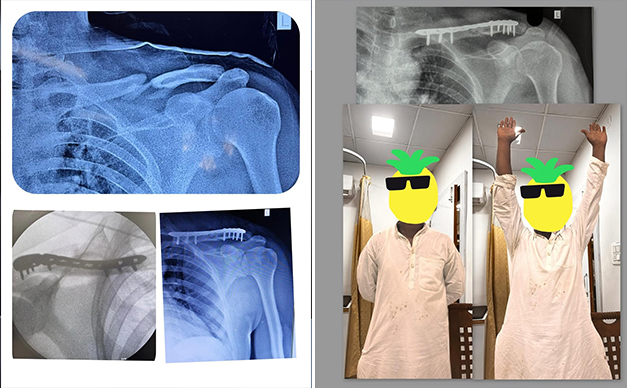
- Here is a case of 35yr/M with communited fracture left clavicle.
- He was operated and fracture was fixed with anatomical locking plate.
- Here are Preop, intra-op, immediate post-op and 2 months follow-up radiographs and clinical photos.
- Fracture is healing and patient has regained his full range of motion and power.
- 👨⚕️ Clavicle fractures are common — but with the right approach, they heal well. Plate fixation, when indicated, ensures strength, alignment, and optimal function for an active lifestyle.
Restoring mobility, restoring life.🤞🏽✌️🤞🏽✌️
#Orthopedics #ClavicleFracture #BoneHealing #PlateFixation #TraumaSurgery #ShoulderInjury #OrthoCare #upperlimbfracture #lockingplate #rehabiliation #physiotherapy